BijouBlog

Interesting and provocative thoughts on gay history, gay sexual history, gay porn, and gay popular culture.

I Love a Gay Halloween Parade!

posted by Madame Bubby

Yes, it's coming up, the unofficial LGBTQ holiday, Halloween! I was looking online for more information about Halloween events going on next week, and I noticed that the famous Greenwich Village, New York City Halloween parade is now in its 46th year.

Pretty amazing, if one thinks what year it was 46 years ago: 1973. Thus, celebrating Halloween was part and parcel of the then young and militant gay liberation movement.

I remember seeing from a distance many years ago Chicago's own LGBTQ Halloween parade on Halsted Steet, and now the event has become “Haunted Halsted Halloweek and Parade,” running from Saturday, October 26 to the great day itself this year, and the day of the parade, Thursday, October 31.

Why am I essentially advertising the above events? Because I think, in tandem, Bijou Video provides its own parade of Halloween porn movies you can enjoy anywhere and throughout the entire year. In fact, I would even say Bijou is carrying on the legacy of directors and producers and actors who originated the genre of Halloween porn or horror porn.

Here are some of our films of that genre:

The anthology Scared Stiff features scenes from some of the titles described below, plus others like Gayracula and Four in Hand.
 

Scared Stiff box cover

Vintage Gayracula ad

Four in Hand still
Image from Four in Hand

Night of the Occultist, a Jaguar film from 1973 (year of the first Village Hallloween parade!) directed by Kenneth Andrews, is certainly overall quite “trippy,” but the major Halloweeneseque scene in this campy yet also complex film is an ancient Egyptian ritual, a sacrifice to Osiris, the judge of the dead (he serves as the gatekeeper between life, death, and the afterlife), which involves gay sex in an temple.
 

Night of the Occultist still
Image from Night of the Occultist

A Ghost of a Chance, also from 1973, features some ghostly sex with a deceased boyfriend, but the overall story is not just about the crossing of the seemingly insurmountable boundary between death and life, but about how sex with multiple partners itself is a way of liberation from imposed boundaries.
 

A Ghost of a Chance stills
Images from A Ghost of a Chance

Strictly Forbidden, a Hand in Hand film from 1974 directed by Jack Deveau, reimagines the ancient trope of a statues coming to life as the main character enjoys sexual contact with many in a Parisian museum.
 

Strictly Forbidden stills
Images from Strictly Forbidden

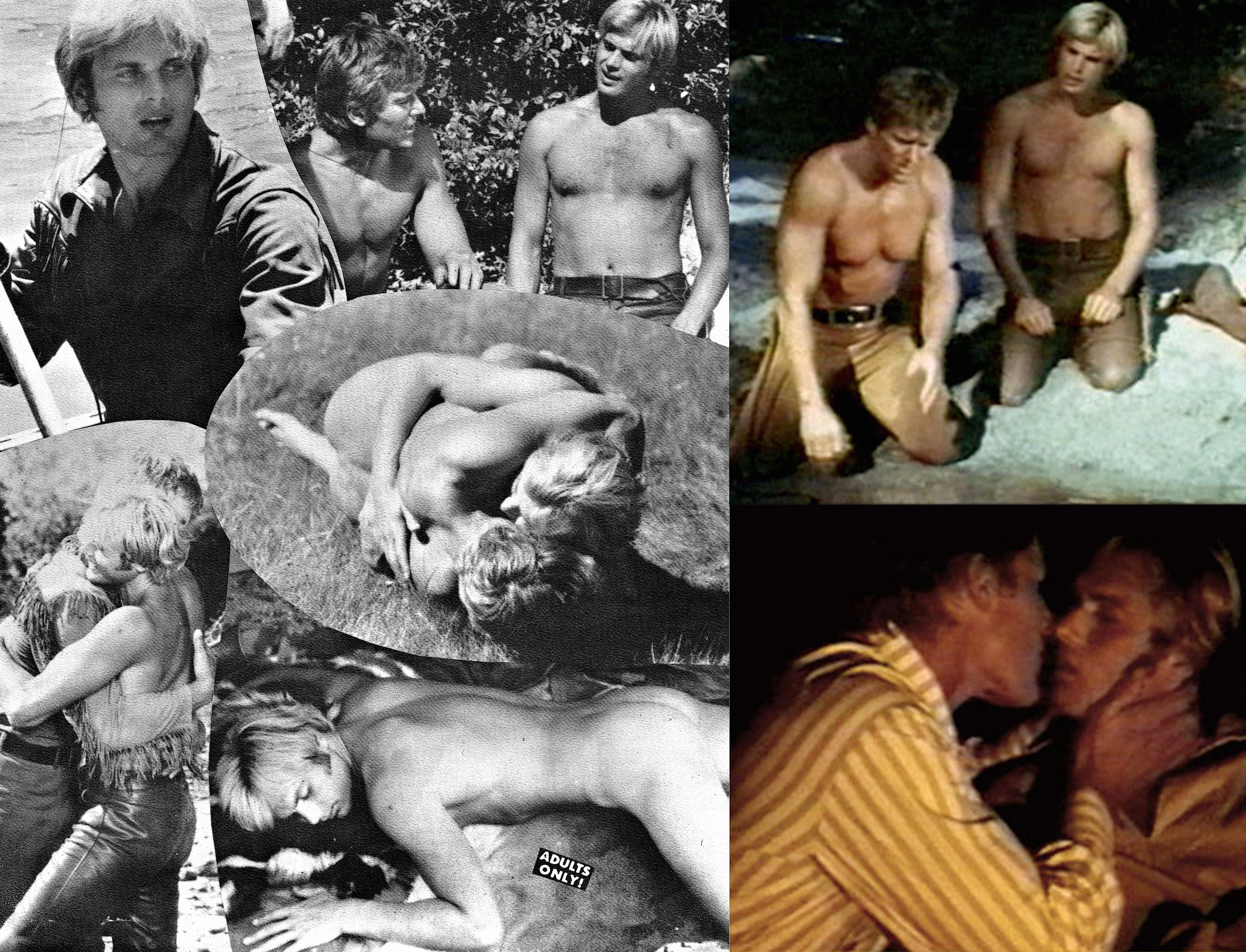
Falconhead, a complex, profound film from 1977 directed by Michael Zen, plays with some archetypal images such as mirrors and falcons as several men undergo rituals of initiation that involve mysterious, ambiguously violent interactions.
 

Falconhead stills
Images from Falconhead

And, perhaps the true depths of the genre occurs in Peter de Rome's The Destroying Angel, which combines religion, psychedelic drugs, sex, and violence in one amazing conflagration as a young priest abandons his vocation and plunges into what is really the depths of himself he had previously repressed.
 

The Destroying Angel stills
Images from The Destroying Angel

What's interesting and significant about these films is that, yes, they are related to Halloween, but not in the conventionally “spooky,” explicit way.

By wrestling with the endlessly mysterious and fascinating conjunctions between sex, death, religion, and violence, they really end up targeting the deep, primal roots of the holiday, something LGBTQ persons, themselves cultural boundary-crossers, can connect with intimately.

It's a day when boundaries dissipate, masks and costumes make us aware that persons are not all what they seem, and somehow we end up experiencing on various levels death and life becoming one.

  3498 Hits

The Legacy of Scotty Bowers: A Brief Reflection

posted by Madame Bubby

Scotty Bowers, recent photo

Scotty Bowers, a legend in Hollywood’s sexual underground in the 1950s and 1960s, died at home in Los Angeles on October 13 at the age of 96.

When I found out about his book, Full Service, I must admit I was excited to read it, mostly because I always enjoyed titillating, “Hollywood Babylon” scandals. And here was someone who actually made satisfying the sexuality of Hollywood royalty of that period (and others) his business, literally.

He started his “infamous” gas station procurement network in the late 1940s, mostly hiring out young studs for closeted gay actors and others in the Hollywood business (and there were many).

According to his book, his career as a sex worker began in 1946 while he was working as an attendant at The Richfield Oil gas station located at 5777 Hollywood Boulevard, at the corner of Van Ness Avenue. In 1950, Bowers stopped working at the service station, and he then began working as a party bartender (one his party “tricks” involved using his schlong to stir drinks), while continuing his sexual services to both men and women. And he himself, because he was gifted with such a stunning endowment, according to Bowers, was quite popular.
 

Young Scotty Bowers
Young Scotty Bowers

I must admit I was surprised that the famous Hollywood actor Walter Pidgeon, whom I call Mr. Miniver (he was Mrs. Miniver’s [played by Greer Garson] husband in one of the most wholesome, inspiring, patriotic 1940s movies, Mrs. Miniver), was one of his first clients. It’s still sometimes difficult to separate the screen persona from the real person (and in Pidgeon’s case, he was married to a woman, of course), but that was Hollywood: ultimately, illusion.

What I found to be, according to Scotty (and I don’t dispute at all his reliability in this case, as many others do), the close to ultimate Hollywood illusion: the Spencer Tracy and Katharine Hepburn romance. I remember when growing up, it was pretty much a given that these two were the romantic Hollywood power couple of the period (at least before Burton and Taylor came along). Yet, according to Bowers, both were gay (or in Tracy’s case, probably bisexual), and Scotty apparently was one of his sexual partners. Hepburn, who some have argued was really more fluid in her relationship to gender and sexuality, used Bowers as a means to “hook up” with several women.
 

Young Scotty Bowers
Spencer Tracy and Katharine Hepburn

But what I think when reading the book and also viewing the documentary (I made a special trip to see it), Scotty and the Secret History of Hollywood, is that one can get distracted by all the Old Hollywood “scandal” and peccadilloes.

Scotty himself suffered many tragedies in his life that are perhaps closely related to, or perhaps not, his life a sex worker. He lived with a common-law wife whom he met right after his service in WWII, but they grew apart, and the daughter by this marriage, Donna, died young from complications after an abortion.

He did finally manage to find happiness with his last wife, but looking at the documentary, it’s clear Scotty suffered, especially later in life, from a hoarding disorder. I remember, and this behavior is that of a typical hoarder, a scene where he is going through memorabilia in a rented storage space stuffed to the maximum. Yes, there’s history made visible in the things he cherishes, but it seems buried, hidden, physically and mentally in clutter, multiplicity out of control.

Hidden and buried, yet now, no longer a secret. Scotty helped others keep secrets, but he never made his sex life a secret. He gloried in it. And I also think it wasn’t just a case of someone who knew he could use his sexuality as a commodity. Of course, he did, if one interprets his legacy very literally. Old Hollywood needed and wanted him to keep its illusion of heteronormative glamour intact.

But in doing so, he ended up exposing that illusion, not out of spite, but because in a world that was built on dreams and illusions, he actually fulfilled in the most primal, honest way the personal dreams of the stars who embodied on screen the dreams of people who probably got their gas pumped (and much more) at the Richfield Oil Gas Station.

  2537 Hits

LGBTQ Rights are Human Rights


posted by Madame Bubby

As the Supreme Court hears seminal cases that may determine the right of LGBTQ persons to work and live without discrmination, I found this quote in a recent article on the first time LGBTQ persons spoke at the Democratic National convention. McGovern was a Democratic candidate, and in the Catholic Democratic households I grew up in, he was our candidate. But of course I was growing up without any knowledge of persons who did not love heteronormatively.
 

Madeline Davis
Image Source: qweencity.com

Madeline Davis, a pioneering lesbian activist who was a cofounder of the Mattachine Society and one of the first university professors to offer classes about lesbians, made this speech:

"My name is Madeline Davis. I am an elected delegate from the 37th Congressional District, Buffalo, New York. I am a woman. I am a lesbian. We are the minority of minorities. We belong to every race and creed, both sexes, every economic and social level, every nationality and religion. We live in large cities and in small towns, but we are the untouchables in American society. We have suffered the gamut of oppression, from being totally ignored or ridiculed, to having our heads smashed and our blood spilled in the street. Now we are coming out of our closets and onto the convention floor to tell you, the delegates, and to tell all gay people throughout America that we are here to put an end to our fears – our fears that people will know us for who we are – that they will shun and revile us, fire us from our jobs, reject us from our families, evict us from our homes, beat us and jail us. And for what? Because we have chosen to love each other."

What is particularly telling about this speech, from those heady early days of gay liberation, is that the content is still frighteningly relevant. Everything she has claimed LGBTQ persons suffer, essentially, a social death, is still occurring, even with laws that have been created, at the bare minimum, to allow, yes just allow, LGBTQ persons to subsist in our country. Subsist, but not enjoy, the freedoms most Americans have long taken for granted.

The fact that the cases the Supreme Court is hearing now still starkly reveal that placing one's human rights in the hands of other humans shows that freedom and human dignity do indeed hang on a thread. The rainbow flag and the United States flag are literally fragile and it just takes one match to burn them.
 

Rainbow flag flying with an American flag
Image Source: NBC News

LGBTQ persons can get married; they can tweet from their phones. But these freedoms are dead ends unless everyone embraces with a full heart, and not just understands from a distance, that no one is safe until everyone is safe to live as whole persons who can love without fear.

  2017 Hits

Nitty-Gritty City

posted by Madame Bubby

I moved into the nitty-gritty “big, bad” city in the middle of the 1980s. I rented a small, in fact, tiny, one-bedroom apartment for $425.00 a month, heat included, not far from Wrigley Field. The hoary Music Box Theater was within walking distance, still a major cultural center of the area. A mom-and-pop hardware store was among the retail establishments.
 

Music Box Theater
Image Source: https://musicboxtheatre.com/about-us/theatre-history

The Southport Avenue strip was dead at night. Signs of gentrification were occurring, mostly originating from well-heeled types who could afford to buy and rehab the large vintage dwellings that once housed working-class, white ethnic families.

One could hear wild metal and punk bands at the nearby Cabaret Metro, and the gay bars of Halsted Street were a cab ride away. Hustlers worked some corners to the east on Broadway. And, just a couple blocks to the north of my pad, the bar El Gato Negro, (picture at link) a dance club with a primarily Latino and trans clientele, was the scene almost every night of brawls. Yes, chair-throwing and punches.

I'm working with a cliché here, I admit. The strip has changed. It's all spas, boutiques, specialty restaurants and bars, geared toward the new well-heeled white jock/cheerleader types Chad and Brad and Taylor and Justine, many of whom are now pushing strollers. I am stereotyping; in fact, many of those who can afford to live in gentry-land make big money in the tech industries, as well as the more traditional legal and medical fields.

These new cityscapes of wealth don't possess the size and power of Silicon Valley in California, but the comparison is potent. Those who make money expect certain goods and services, and they are willing to pay for them. A $425 a month non-rehabbed apartment with a flower-power vinyl kitchen floor doesn't fit into this cut glass, opulent, homogenized landscape. The same apartment now goes for $1,350.00 a month (considered a bargain), and the kitchen and bathroom approximate the vast stainless steel and marble and quartz rooms in the million dollar condos where cooking often comes from a delivery box.

The situation in San Francisco, the most expensive city in the United States, is like this Chicago urban experience on steroids. Having just finished Armistead Maupin's Tales of the City, where Anna Madrigal owns a gorgeous building with its own garden and can welcome new tenants with a joint on the door, the article that claims, “readers' first San Francisco rent prices will make you cry,” really wounds. Deeply. Bohemian paradise lost.
 

Barbary Lane
Barbary Lane

Here are few first hand accounts from that piece:

“1974 – $145 for a beautiful one bedroom apartment on pacific between Fillmore and Webster!! elevator had gate you had to to open and close. no bay view but all i had to do was walk to the corner and gaze at the most beautiful city. that was then. possibly 2340 Pacific? (those were the ’70s after all.)”—cicinla

and

“1975. Hyde and Sutter. 6th floor Studio with built-in antique (lukewarm) refrigerator, 180 degree view over the city. Furnished it with treasures out of a dumpster on Larkin. $105.00 a month. Now goes for $2195.00.”—George Reeds
 

San Francisco, 1970s

and

“My first apartment was $245 a month on Dorland Street off Dolores in 1977. A spacious one-bedroom with a large kitchen with many glass-fronted cabinets and a huge bathroom containing a linen cupboard with drawers underneath and completely tiled. Night-blooming jasmine grew on the hedges in the backyard and their scent permeated the place when I opened the windows in warm weather. I loved it.”—Carolyn Zaremba

The cities are becoming suburban. The cities are living exhibits of profound income inequality and racial segregation. Yes, true, brutally true, but what I find worrisome is the association of those who had to flee from where they live with not just crime, but with activities that don't gel with a variety of norms, ranging from heteronormativity to late capitalist exploitation. I admit I've made that connection earlier in the blog, but does a “nice, safe” neighborhood necessarily mean an expensive, and usually segregated one?

Even gays and lesbians, who have earned a reputation as being one of the first urban pioneers (one might say colonizers) to take some previously nitty-gritty areas like Castro Street and Halsted Street, and make them safe spaces (in the meantime doing themselves the physical labor of rehabbing), aren't always the direct beneficiaries of their labors.

Now younger LGBT persons are once again trying to make their living on and in the physical and economic margins, but often without that funky edginess their ancestors experienced in the nitty-gritty, big bad city where there was an all-night unique diner on every corner and your eccentric landlady with her purple wig who you knew personally might invite you over for a nightcap.

  2899 Hits

Casey Donovan on Stage: The Theater Career of the First Gay Porn Superstar

posted by guest blogger Miriam Webster


Tubstrip poster


Casey Donovan, who became a legend after his lead performance in Wakefield Poole's Boys in the Sand, was easily the very first true gay porn star. Released in 1971, the film made its debut in the early days of gay liberation as well as the early days of hardcore (the era of “porno chic”), making a significant impact. It premiered at New York City's 55th Street Playhouse, which typically screened foreign and art house cinema, and was the first gay porn film to achieve crossover success, to garner considerable attention from the press, and to be reviewed by Variety, even making it onto their listing of the top fifty grossing films its opening week. The wild success of Boys rapidly helped to launch Casey, with his charm and glowing good looks, into underground fame and turn him into a gay icon. There was talk, at the time, that Casey might be the adult star who could fully break into mainstream film. Casey had aspirations of realizing this potential, and also of appearing in Broadway productions. He had been, and continued to be, involved in theater all his life, as an actor and as a lover of the medium.

Casey, born John Calvin Culver and typically known (and credited outside of his adult career) as Calvin Culver or Cal Culver, was raised in upstate New York. He did theater throughout high school and college, after being encouraged and mentored by his beloved high school English and drama teacher, Helen Van Fleet. (Roger Edmonson's biography Boy in the Sand: Casey Donovan, All-American Sex Star, source of the majority of this material, says he called her Auntie Mame, writing to her and sending her tickets to his plays throughout his life. “He took her backstage to meet Ingrid Bergman when he was in a play with the legendary actress. He took her to the Tony Awards, arranging for her to sit front and center in the audience.”)

When he eventually relocated to New York City in the late '60s, Cal made sure to attend as many plays as possible, from Broadway to small productions. He briefly moved to New Hampshire to do summer stock and joined the reputable Peterborough Players as an apprentice before returning to NYC, where he was chosen as a replacement for an actor in the off-Broadway play Pins and Needles. The success in 1968 of Mort Crowley's play The Boys in the Band, which directly focused on gay characters, paved the way for gay-themed plays. Cal was hired as an understudy in an early gay-themed play, And Puppy Dog Tails, in 1969. Around this time, Cal says (in a TV interview on Emerald City) that he was broke and searching for jobs in a paper and saw an ad hiring performers for non-hardcore roles in straight sex films. He wound up doing two "very strange little films" called Dr. X and Twin Beds, making $20 a day.

In 1970, he was cast in a raunchy low-budget thriller, Ginger (dubbed “a female James Bond”), with Cal in a role featuring some nudity. The film was critically panned, but Cal's performance received one of the few positive mentions: “Only Calvin Culver as the thrill-seeking jet set blackmailer shows any indication of better things to come.” Following Ginger, he was featured in a short run of the play Brave, following which he met Jerry Douglas. The two would go on to work together numerous times and in several capacities over the years. Douglas was directing a production of Circle in the Water, another gay-themed play, and brought Donovan on board. Douglas was impressed with how professional and charming Cal was, but commented that he was mysterious: “He always vanished promptly after each performance, not to be heard from until his next call.” Cal had a busy social life, was hustling and cruising after hours, and still making time to frequently see plays and operas.

Just before Boys in the Sand, Cal broke into the hardcore porn world at age 28 when he starred in the 1971 film Casey, originally produced by Palm Features, later picked up by Hand in Hand Films, and currently distributed by Bijou Video. This film, though produced before Boys, wasn't substantially screened until after the release and success of Poole's landmark film. A co-star from one of the sex films Cal made in 1969 had a friend (Donald Crane) who was writing and directing a gay hardcore film and was looking to cast the lead. Cal needed cash and they were paying well, so he took the job. Though he described the shooting of Casey as uncomfortable because of its largely straight and tense crew and cast, Cal carries the film, attempting to create eroticism in the (mostly faked) sex scenes, exuding plentiful charm, and expertly delivering the film's clever and incisive dialogue, full of commentary on gay life in the era. Casey was well-reviewed when it did get distribution. Edmonson's biography says, “Aside from Cal's timelessly watchable good looks, there was his performance. It was a tour de force of its type... Cal not only plays the callow hero, but he also plays [in drag] the role of Wanda Uptight, his own fairy godmother... He played the role to the hilt without a trace of embarrassment, making it one of the more memorable star turns in the history of porn films.”
 

Stills from Casey
Images from Casey

Casey is notable not only for being Cal's first hardcore porn – as well as one of the few films to properly make use of Cal's acting chops – but also, significantly, for giving him his pseudonym and alter ego. As he was modeling for a “legitimate agency” at the time and acting, Cal took the name Ken Donovan for his credit in this film, modifying it to Casey Donovan for his later porn appearances.

Because of Casey, Cal received a call from a friend who knew someone - a former dancer, theater director, and choreographer - who was making "some experimental movies" on Fire Island. This was Wakefield Poole. Cal met with him, saw some of what he'd been shooting, and agreed to take part in this beautifully photographed porn film, which was ultimately to become the classic, Boys in the Sand, that would transform Cal/Casey's life. He received glowing reviews of his performance and his image in the film and there was talk all over New York City (and, eventually, across the nation) about him.
 

Boys in the Sand still
Boys in the Sand poster


In 1972, Cal was cast in a small part in the George Bernard Shaw play Captain Brassbound's Conversion starring Ingrid Bergman, who described Cal as “having the same kind and as much charisma as Robert Redford.” A photograph of them together during this production became one of Cal's prized possessions and he said he learned a great deal from getting to watch Bergman act.
 

Cal with Ingrid Bergman


Cal with Ingrid Bergman

Jerry Douglas, his Circle in the Water stage director, contacted Cal about appearing in his porn directorial effort The Back Row (1972) co-starring George Payne. In Douglas' Manshots article “The Legend of Casey Donovan” in April of 1992, Douglas, who worked with Cal multiple times in both theater and porn productions, describes how Cal “approached stage and film work in much the same way. He began by creating the character... and by studying the script, even on porn films. Rehearsals and shoots were always filled with his laughter, easy and laid back, even in the middle of an intense sex scene. But performing or filming was always a job to him, and a job he took very seriously.”

Shortly thereafter, Douglas was adapting his swinger play, Score, for the screen and Cal was cast. The film – a talky and very entertaining, nearly-hardcore softcore bisexual film – was made by notable director Radley Metzger. Metzger had come from straight and lesbian softcore films and was soon to move into glossy straight hardcore films (including one of his more well-known works, 1976's The Opening of Misty Beethoven, which would feature Cal in a small role). The sex scenes between Cal and co-star Gerald Grant are the most explicit and erotic in the film, the chemistry and tension between the two palpable, and Cal – here, as in Casey – deftly handles a significant amount of dialogue and delivers a compelling, nuanced performance.
 

Cal Gerald Grant in Score
Cal with Gerald Grant in Score

In the following few years, Cal appeared in a handful of small non-porn film parts and met with a number of producers in mainstream film about potential large-scale projects. Stage and screen co-star Michale Kearns said, “He was really, seriously talked about as potentially crossing that invisible line into the mainstream world of Hollywood films. His acting was immaterial. He was a star. He had that ineffable quality...” A Variety article said Cal could be “the bridge from hardcore to legitimate features” and Cal believed he could make that transition. His friend and then-roommate, Jake Getty, says, “He really didn't see – and I honor him for it – the difference between the two mediums. To him it was all an expression of theater... There was a great deal of legitimate theater with nudity and sex, implied sex in any case. Cal felt that there was no difference, that it was just a matter of how you perceived it. For him it was all a matter of the expression of emotion. He saw no difference between the nudity in Hair and the nudity and sex in Boys in the Sand.” But Cal's Hollywood roles never quite manifested.

In 1973, Cal played a series of small parts in a Lincoln Center production of The Merchant of Venice starring Rosemary Harris and Christopher Walken. One of his roles was as Jesus Christ, wearing only a crown of thorns and a g-string and carrying an 8-foot cross. This production featured, also in small parts, Robert Tourneaux of the theater and film versions of Boys in the Band. Tourneaux was in a similar predicament to Cal, even without a porn career – his notoriety as a gay actor and from a well-known gay role was putting a stop to his film career.

As Cal was beginning to realize, the dual stigmas against porn and out gay actors were preventing his Hollywood aspirations from manifesting. Wakefield Poole said he also experienced this inability to move into mainstream film directing because of his porn work: “The legit film line couldn't be crossed. They would exploit you, but they didn't dare let you do a legitimate movie. The ugly truth was that there was no crossing over. None at all.” (Correction: There were some exceptions; gay porn director Tom DeSimone successfully crossed over into mainstream film/television directing. See our recent interviews with him about his career.)

Cal, in a 1983 Men in Film interview, said “Perhaps I was naive but it was a rude awakening for me to find out that Hollywood is one of the most closeted and hypocritical cultural centers in the world. I learned that an openly gay actor like myself was not welcome to gay directors and producers who believe it is essential to keep their sexuality a secret. Once an actor has made a porn movie, it is very difficult to 'cross over'. And it all has nothing to do with how much talent one has. It is all about how an actor is perceived and prejudged. In a limited sphere, my films made me famous, but in another sense, they were a handicap. I tried to maintain separate names and identities at first... It got increasingly confusing... Besides, the secret could not be perpetuated endlessly.”

Cal gave up his Hollywood hopes eventually, but continued to perform in porn and in theater. He was dropped from a production of Frederick Combs' play The Children's Mass, in which he was to co-star with Sal Mineo (also a friend of Hand in Hand Films heads Jack Deveau and Robert Alvarez), but he worked with Jerry Douglas once more in 1974 in his bathhouse play Tubstrip, also starring Score's Gerald Grant and a fellow early porn star, Jim Cassidy.
 

Tubstrip playbill

Cal was the biggest attraction and the play had a long run in New York, then runs in L.A. and San Francisco, and Cal performed in it to the end. Fans were excited to see Casey Donovan live and Cal “made time to meet with fans who gathered at the stage door every night after the performance.” During this era, he would reportedly screen his porn films for his theater cast-mates at after parties (Boys in the Sand for the Merchant of Venice cast and Poole's 1974 film Moving, co-starring Val Martin, for the Tubstrip cast). Michael Kearns commented on one of these viewings: “He acted like it was Gone with the Wind. He really behaved like a star – not temperamental but like a real star. He didn't feel a bit of shame about what he did on the screen. Even when he was getting fisted, there was a certain elegance about him. He had incredible aplomb.”

Between porn and theater gigs, Cal continued to work as an escort, periodically served as a gay celebrity tour guide on international trips (including to Italy, Egypt, China, and Peru), and did a stint running a bed and breakfast (“Casa Donovan”) in Key West. In his porn career, he worked with with major directors, stars, and studios, including Falcon (The Other Side of Aspen, 1978, co-starring Al Parker and Dick Fisk), the Gage brothers (L.A. Tool & Die, 1979, and Heatstroke, 1982), Christopher Rage (Sleaze, 1982), Poole again (Hot Shots aka Always Ready, 1982, and Split Image, 1984) and Steve Scott (Non-Stop, 1984), and he performed in the 1985 safe sex films Inevitable Love (with Jon King) and Chance of a Lifetime.

After a break from the stage and from New York City, Cal planned a return with a 1983 off-Broadway revival of the Terrence McNally play The Ritz. The play, which originally ran on Broadway in 1975 starring Rita Moreno, Jerry Stiller, Jack Weston, Kaye Ballard, and F. Murray Abraham, was based on Bette Midler's rise to fame at The Continental Baths in the early '70s. (An additional connection to Cal: McNally originally called the play The Tubs, but when it was to be produced on Broadway, its name had to be changed because it was too similar to that of Douglas' Tubstrip.) Cal was brought onto the play's revival as a co-producer, as well as a star, and helped to finance it. Cal played detective character Michael Brick, who spoke in a falsetto voice throughout, and Warhol superstar Holly Woodlawn was cast in Moreno's leading role. The revival wound up a critical and financial disaster, the director receiving the largest amount of backlash, and only ran one night. Woodlawn said, while that performance was a mess, “Everyone panicked too soon. The opening night was a horror, but if given a chance, things would have settled in and worked out... We just needed more time to make it work.”
 

Poster for Woodlawn and Donovan in the revival of The Ritz
Holly Woodlawn and Cal

After this disappointment and its financial impact, Cal returned to Florida and was never to appear on stage in New York again. However, he couldn't give up on theater and – when not away traveling – attended and began acting in community theater productions in Key West. There, he was in a production of The Prime of Miss Jean Broadie and in William H. Hoffman's pioneering play about AIDS, As Is.

Woodlawn called Cal “the most gracious man I've ever encountered.” His friends remarked upon how dedicated he was to his fans and, while an enigma and a mass of contradictions, how sensitively he received the people he interacted with – strangers, fans, clients, co-workers, lovers, friends. Douglas' Manshots article says Cal “knew that he was a pioneer, a role model, and a superstar with obligations to his public. And so, he took great pains always to appear in public well-groomed and sober. He charmed his fans in every public appearance by listening, again and again, to their personal tales as if each of them were his closest friend. He corresponded with many, sent out hundreds (maybe thousands) of photographs at his own expense, and was never in too much of a hurry to sign one more autograph.” Bijou owner Steven Toushin similarly recalls Cal's appearance at the Bijou Theater. He was booked there to promote a film, dance on stage, and to meet fans and sign autographs. He says Cal had a great time interacting with the customers and stayed hours beyond the time he was scheduled and paid for, enjoying having conversations with his fans.
 

Signed Casey Donovan headshot from his Bijou appearance

Cal's hardcore and softcore films serve to immortalize his charm and his talent, as both an actor and a sexual performer. Though his porn roles modified his acting career, in a Men in Film interview, Cal said, “I enjoyed the idea that I was doing something that very few people had ever done... My life was made much more exciting by having done those films... I did plays, I was on magazine covers, in national fashion ads... I think porno worked in my life because I was so honest about it... Once I realized that my appearance in gay films was held against me in some quarters, I decided to put sex to even greater use – not less – in augmenting my income. We live in a society with deeply rooted feelings of guilt and shame about sex of any kind. If somebody makes a porn film, they are automatically beyond the pale. If somebody hustles, there must be something wrong with him. Maybe for some, not for me. I'm the living proof that it doesn't have to be that way. I'm still pretty much 'the boy next door' that I always was... I think my greatest accomplishment so far is something that doesn't show up in lights or get reviewed – and that's simply the sexual sanity that I have tried to contribute to over the past twenty years... I've tried to be honest, kind, and understanding with as many different people as possible, and I think that's much more important than just being gay.”

Cal's friend Jay McKenna wrote in a memorial article in The Advocate, “To myself and other young boys who were coming out in the early '70s, Cal Culver was a gay Adam – the first widely embraced gay symbol to appear during the post-Stonewall years. Back in 1971, when Cal's first film, Casey... was released, the gay movement was just beginning to amass some collective energy and wider acceptance, but gay existence was still underground and closeted. Coming out was a heartfelt and courageous choice. It was a calculated professional and social risk. So to teen-age boys like myself who were struggling to come to terms with it, Cal's spectacular emergence as Casey Donovan, unapologetic star of gay films, bordered on the heroic... My memory of him isn't obscured by false nostalgia. Cal had star power. He celebrated his gayness. He made me and others proud to be gay, so contagious was his spirit. Of course, like any human being, he had good days and bad days. But to be in his presence was to breathe a rarefied atmosphere.”

In 1985, two years before his death of AIDS-related complications, Cal returned to his home town to help his beloved drama teacher, Helen Van Fleet, celebrate her retirement. He visited with old high school classmates who all knew about his career in “the legitimate theater” and some about his porn career. Cal wanted to play a big part in Mrs. Van Fleet's celebration. Her daughter said, “it was really wonderful. He had written a parody of the title song from the musical Mame, and he sang it to her. It was an account of all the things they had experienced together over the years. It meant the world to her” and it received a huge ovation.

Sources:

Roger Edmonson, Boy in the Sand: Casey Donovan, All-American Sex Star

Jerry Douglas, “The Legend of Casey Donovan,” Manshots, April 1992

Jay McKenna, “Casey Donovan: To an Idol Dying Young,” The Advocate, October 27, 1987

https://en.wikipedia.org/wiki/Casey_Donovan_(actor)

https://newyorkcityinthewitofaneye.com/2013/05/20/mondays-on-memory-lane-1981-one-night-only-at-the-ritz-with-holly-woodlawn-2013/

Emerald City TV #47, Wakefield Poole & Cal Culver

  11680 Hits
GO to Top