
BijouBlog

Interesting and provocative thoughts on gay history, gay sexual history, gay porn, and gay popular culture.

Turned On at the Barber Shop

posted by Madame Bubby

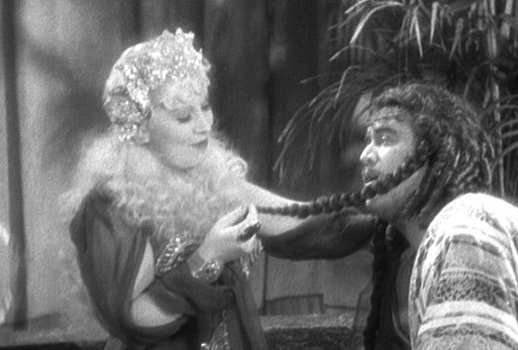
“There's one lady barber that made good,” croons Mae West, singing Delilah in the opera Samson et Dalila by Saint-Saens in an attempt to be a high-class dame.
 

Mae West as Delilah

Since my regular haircut lady retired and moved to Florida, I've been searching for a haircut place. After a few unsatisfactory visits to a salonesque male haircut place (blasting music, “cool” décor, a differentiation between a stylist and barber), I settled on a place in walking distance of my house that bills itself as a barbershop.

Think old-fashioned barbershop. Plan white walls and white floor tile, the iconic striped barbershop pole, a box for hot towels, straight razor shaves… The place bills itself as offering a “masculine” experience, emphasizing for example playing sporting events on the television (I go in the morning purposely as to not be subject to “the game”).
 

Vintage glass barber shop pole

But lest one think this is some kind of man-cave redneck frat boy paradise, its clientele, because of its location, are mostly gay. And as far as I know, the place employs at least two lady barbers.

I've set myself up with a totally straight, married with kids, overall kind of nondescript by celebrity standards of beauty Russian barber. The heart to heart confidences I enjoyed with my regular haircut lady don't occur, but it's kind of a relief to go on about subjects such as lawn mowing and home repair.

But if the conversation isn't stimulating, I noticed I am feeling that twinge in my shorts when he grooms me. That's what he is doing, and he takes much time in grooming the beard and mustache and the eyebrows after the haircut. The last time, his bare hand touched my face, not purposely, but it was certainly stimulating, however brief.

And add to that sensation the shaving cream, the straight razor, and to provide some form of climax, the the hot towel on the face.

Perhaps the turn on comes from just being in that chair, not free to move, no glasses on my face. I can zone out and just let him in his manner “do me.”

Hmm... one might say, why don't you just go for a massage if you want some hand action, and you could get some young hot stud to touch you…

Yes, I could, but maybe it's the subtlety of the experience, and that it's homoerotic without being overtly sexual, and that it allows more room for fantasy, that creates that increasingly irresistible turn on.

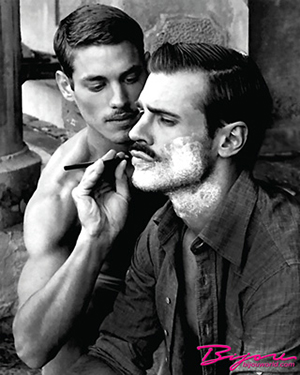
For more homoerotic grooming/shaving imagery, check out of one of our best-selling posters, "Close Shave".
 

Close Shave poster
"Close Shave" poster

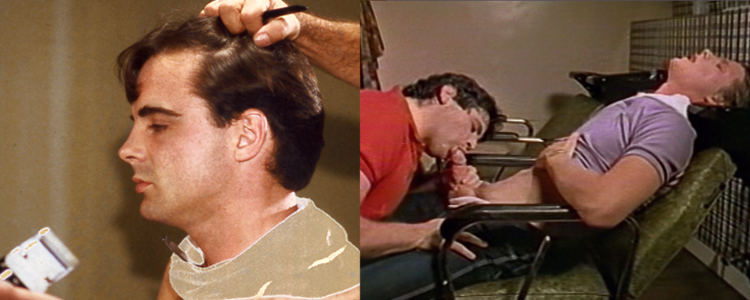
Two classic Steve Scott porn films feature related scenes: A Few Good Men (1983) opens with an extended sequence of a young military recruit having his head shaved and his mouth filled with dick (belonging to Al Parker, seen only from the waist down) and I Do! (1984) features a barber shop sequence between customer Andy Fuller and his beefy barber (Joe Marconi), who kneels to give him head at the shampoo sink.
 

A Few Good Men and I Do images
Images from Steve Scott's A Few Good Men & I Do!

And check out two Bijou original series: Love a Man With a Beard (Volumes 1, 2, 3, and 4) and Love a Man With a Mustache (Volumes 1, 2, and 3), collections of hot vintage porn scenes for fans of men with facial hair.
 

Beard and mustache compilation images
Images from Bijou's beard and mustache series
  1966 Hits

Condoms Before the Days They Were Rubbers!

posted by Madame Bubby

When I was in sixth grade (I didn’t go to a middle school or a junior high), the tougher boys were joking about rubbers. I did not make the connection to condoms until high school, climaxing in the time when, believe it or not, my dad gave me one to put in my wallet. He thought I needed one because I was hanging out with some girls (little did he or, most significantly, I know I was their gay friend, and one of the girls, nicknamed “Inch," was a lesbian).

I digress. Condoms weren’t always rubber. Before the invention of vulcanized rubber in the 19th century, condoms were made usually of some kind of linen smeared with chemicals or, ew, animal tissue or bladder. What’s interesting is that since ancient times they were used as both a means of birth control and a protection against STDs. (Ironically, usually birth control and/or abortion was the province of the woman, who was blamed for issues is in this area, even though, by the Middle Ages, the established view was that the woman was merely the physical receptacle of the life-giving, soul-containing male sperm.)

Some interesting facts about pre and early modern condoms and condom usage:

There’s a legend that the King Minos of Crete, subject to so many curses, used a goat’s bladder as a female condom to protect his partners because he suffered from a strange affliction; his semen was filled with snakes and scorpions.

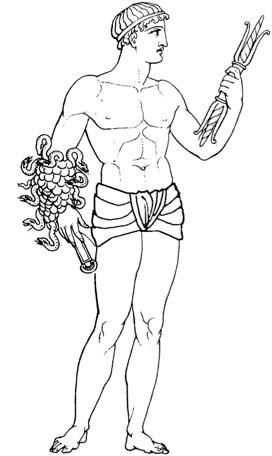
Those short loincloths Greek and Roman guys wore (mostly those of the slave and laborer class), that in the sword and sandal movies showed off hot, muscular legs, often consisted of little more than a covering for the penis. If someone in a higher class wore one of these “lower class” outfits, some have speculated they may have served as form of condom.
 

Ancient Greek man in short loincloth
Ancient Greek man in short loincloth, Source: Pinterest

Sexual norms changed during the Middle Ages with the rise of Christian theocracies, and the emphasis on sex and procreation tended to put condoms under the radar, so to speak, and we also lost some knowledge of their substance and use during the ancient world. Some writings by Muslims and Jews, who during this period in some areas comprised the majority of physicians, mentioned soaking a cloth in onion juice or other perceived spermicides.

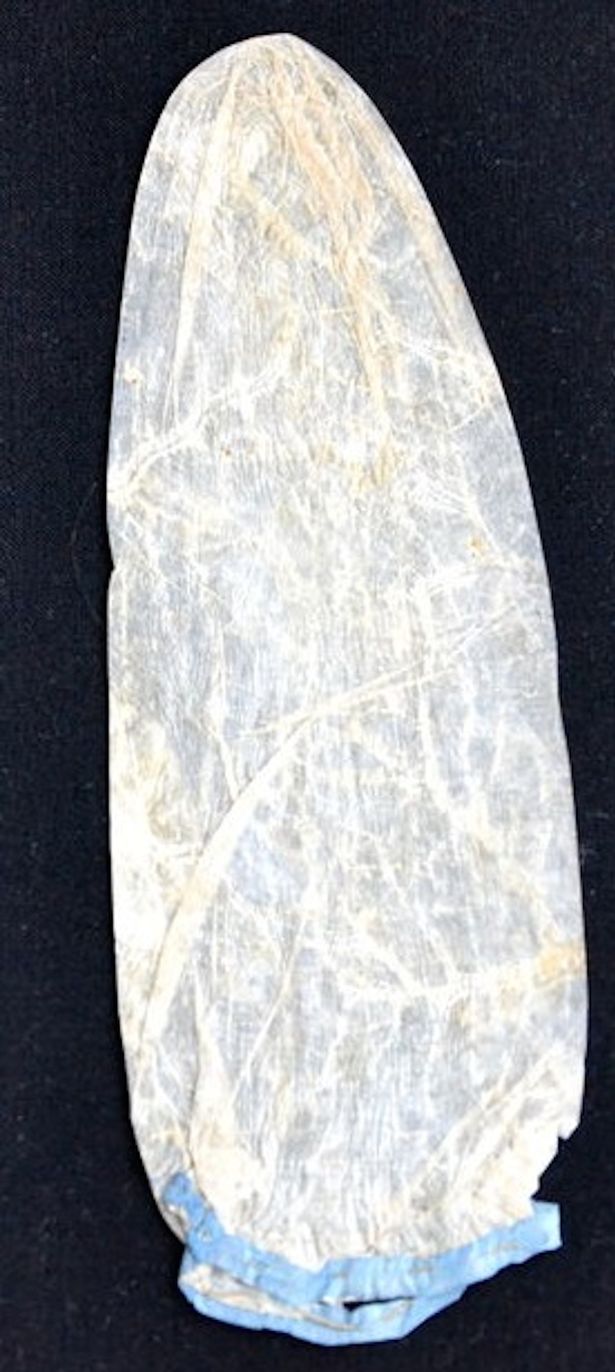
The syphilis outbreak that began among French troops in 1494 prompted an Italian guy named Gabriele Falloppio (from whence we get the name fallopian tube) to pretty much invent the first item we now can define as a condom. He invented a linen sheath sized to cover the glans of the penis, tied to it with a little ribbon, smeared with spermicide. He claimed to have saved the lives of 1100 sailors with the device. Sailors. And with that word, one I think can pretty much imply that these guys weren’t always going after the clichéd wenches.
 

Gabriele Falloppio
Gabriele Falloppio, Source: Sciencemuseum.org

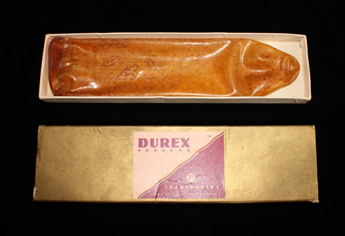
During the Renaissance, condoms were also made of animal intestines or bladders. By the 18th century, they were available in all shapes and sizes; one could buy them especially at the ubiquitous barbershops, which weren’t just places for haircuts. The barbers performed various surgeries, dental work, and especially bloodletting.
 

Retro Durex condom
Condom made of animal intestine, Source: mirror.uk

During the above periods, the upper, and later the burgeoning middle classes, were the ones who used condoms. The lower classes couldn’t afford them, and they also lacked education on STDs.

Now the omnipresent and mostly all-powerful Catholic Church during this time wasn’t exactly keen on the use of condoms as birth control, of course, but it was yet to make its views on the subject official in the Pope’s encyclical Humanae Vitae with the advent of the sexual revolution of the 1960s.

And in the early 19th century, after the invention of the rubber condom which increased usage and convenience considerably, the notorious Comstock Act pretty much made life miserable for anyone who wanted to use any form of contraceptive, much less educate oneself on the issue.
 

Retro Durex condom
Retro Durex condom, Source: sexinfo.soc.ucsb.edu/article/history-condom

The deadly AIDS epidemic of course made the condom a matter of life and death, with the holy haters decrying what condoms had always been used for, saving lives, in favor of reviving the scapegoating of anyone with STDs.

By the way: there was no “Earl of Condom.” The etymology of the word is indeed unknown!

Source: mostly Wikipedia’s article on the History of Condoms, combined with some of my own knowledge of gender/sexuality history

  2311 Hits

Sex and Bathrooms Redux

posted by Madame Bubby

Once again, after being forced to urinate and defecate in the dull and stinky men’s room in the building at the university where I teach, I think once again about the relationship between not just mansex and the men’s room, but the whole sociology of the bathroom.

First of all, the fact I am saying bathroom is significant, because in this dull and stinky men’s room with the constant problem of the unflushed toilet (it is supposed to flush automatically, it does not always do so), there is no bath. La salle de bains? No. Showers are available in the gym, of course, but no bathtub. Why not just call the room the sink/toilet/urinal room?

Second, why are public bathrooms in general such blah physical spaces (unless the ones in expensive spaces)? Yes, they are a public space, and utilitarian in the most basic way, but it seems, not that I would know this, the ladies’ rooms aren’t that different. The luxurious rooms with cushions, chairs, and couches I used to notice in movies made in the 1960s aren’t, or perhaps never were, the norm.
 

Basic public restroom

The unisex/disabled (not parallel terms) restroom the university recently constructed is clean and efficient, and also, and this is a plus to many, private. Single occupancy. Now, that might be interesting, to lock the door and enjoy some action, but that might create more potential for getting caught than doing a quickie in a stall. Knock, knock. Who’s in there? I have to go … I’m calling security.

Thirdly, the issue of privacy is something that seems to be more exclusive to contemporary American/Western culture. Contemporary, I emphasize, because in early modern Europe, urination and defecation weren’t exclusively private acts. People “went” when and where they needed to. Separate bathrooms with plumbing were a luxury, and even those in the upper classes used the chamber pot whenever and wherever, even when dining. Some dining areas and other public rooms contained elaborate close stools for convenient evacuation. The aesthetic features of these receptacles, one could say, were designed to conceal the act as well as blend the object into the overall luxury of the space, but it was clear what people were doing in them. At least, in much humbler settings an outhouse was a private, separate building, but not exactly the jolly T-room.
 

17th century toilet
17th century toilet

I’ve often thought, and perhaps my view reflects how Americans have insisted on enclosing the space and judging a person or institution or business by the cleanliness of their bathroom, that the actual bath and shower should be more separate from the toilet. The juxtaposition of the toilet and the bathing area creates a tension between purity and danger, as Mary Douglas in her book by that title explains. The danger is the expulsion of waste, the crossing of a physical boundary, in this case, the body, however natural this process. It’s not just that the waste itself is toxic or gross, physically. More than instinctual repulsion is going on here, more than concerns about health. We feel the need to control this process, enclose it in a pristine setting. The place to dump the waste must be the cleanest, purest, most private room, treated like a sacred shrine. The toilet is the porcelain god.

Thus, when one puts sex into the bathroom space, the act itself a crossing of physical boundaries which also involves a change of fluids, this purity and danger tension exacerbates. It is interesting that in one’s own private home, one doesn’t usually see the bathroom as a place of sexual activity. It’s the bedroom. One sleeps with another person, and the sleeping verb is a common euphemism for sexual intimacy. Yet, sex acts, anonymous sex, occur in public bathrooms.

Perhaps the connection here is between the words anonymous and public. Any time one even goes into a public space, one is taking a risk, because one is in the position of being seen by others at various levels of intimacy, and in the case of bathroom or toilet sex, what is deemed private becomes public in a space which is enclosed, private, for a private act. One now can see what one has fantasized about seeing. It’s the one moment of connection, the ultimate boundary crossing, the danger, the thrill, the orgasm mixed together in a space designed to enclose a natural, albeit for most, non-erotic process.

  1909 Hits

Down and Out in Paris and London: Where the Gays are Not Out

posted by Madame Bubby

Ok, George Orwell. I had to read Animal Farm in grade school, 1984 in high school, and of my own volition, I read and even identified with the main character the infinitely dreary Keep the Aspidistra Flying (yes, nerdy guys with aspirations to writing and other academic pursuits really shouldn’t try to escape their heteronormative lower middle class roots). And, more significantly, I even snuck a read at my dad’s worn copy of Down and Out in Paris in London.
 

George Orwell
George Orwell (Source: idmb.com)

Supposedly based on Orwell’s own experiences, this book, written in 1933, narratives the life of a down and out academic/artist type who out of necessity has to take first, a job as a dishwasher in a hotel and then a restaurant in Paris, or plongeur (sounds like plunger, very apropos). Then, arriving back in England, he ends up in the heart of “tramp” culture (homeless persons) and suffers from the futile attempts of both government and private institutions to either contain or reform the organic connection between poverty and society.
 

1930s Paris
1930s Paris (Source: https://www.bbc.com/news/world-europe-14372195)

When I read it as an adolescent, I was more fascinated by the seedy details (especially about food preparation, as in, let’s wipe the sawdust off the toast dropped on the floor so the hotel guest can get the breakfast quickly), the suspense that occurs as the persona struggles to obtain basic necessities, and even the threat of and eruptions of violence.

Yet, now, re-reading it, I noticed the author’s virulent homophobia. Yes, definitely a product of the time and place, but even though it isn’t a main theme, it shows up at various cringeworthy points in the narrative in language of contempt or titillation. Orwell assumes this underbelly of society at that time is the place where such persons can pursue their “perverted” desires, which in most cases exploitation of the even less powerful.
 

Down and Out in Paris and London book cover

For example, in recounting his experience as a dishwasher at a hotel in Paris, he titillates, but does not give details, about the “old debauchees who frequented hotels in search of pretty page boys.” The “French episode,” of course, focuses more on illicit heterosexual sex; it’s a given that most of the men will have “mistresses.” Yet, and for Orwell this fact is an indictment on the condition of poverty, no one seems to be married, except for the couple who deceptively sells packets of pornographic postcards to tourists. Deception, because once the buyers open the packet, no dirty pictures, but instead pictures of common Parisian tourists destinations. And the buyers of course are too embarrassed to complain!
 

Men asleep on Southwark Bridge
Men asleep on Southwark Bridge (Source: http://www.workhouses.org.uk/lodging/)

In the “English episode,” however, the attitudes of contempt and disgust toward homosexuality really come to the fore. The persona in his journeys among the tramps ends up at some place called a “spike.” These prison-like places (inmates are locked in for the night) apparently served as shelters for the homeless population during this period. He gets an involuntary roommate for the night in a room with no beds:

About midnight the other man began making homosexual attempts upon me – a nasty experience in a locked, pitch-dark cell. He was a feeble creature and I could manage him easily, but of course it was impossible to go to sleep again. For the rest of the night we stayed awake, smoking and talking. The man told me the story of his life – he was a fitter, out of work for three years. He said that his wife had promptly deserted him when he lost his job, and he had been so long away from women that he had almost forgotten what they were like. Homosexuality is general among tramps of long standing, he said.

There’s definitely an awful truth here, but it’s not the dynamic of same-sex sex occurring in prison or prison-like settings. It’s his view that such relations are perverse, and as Orwell later argues in the book to the point of a tirade, that the lack of stable relationships with women drives these men to such antisocial acts. What’s kind of queer about this account, though, is that the persona doesn’t attack the guy or even kill him; he ends up forming a sort of bond, however forced because of the situation. But then, the fact that the guy is definitely not an effeminate type but really a manly man out on his luck makes such bonding acceptable.

Later, in one the awful cheap lodging houses where the persona spends the night, he encounters an extremely drunk older gent who claims to be in the same social class as him, an “old Etonian” or “public school boy,” that is, someone of the more genteel class with an education. The social bond does not occur here, because the guy is too drunk to even offer him his cherry brandy, and the other occupants of the room yell at him to go back to his bed and shut up. The older gent keeps talking to himself, muttering, (quite tellingly given the persona’s reflection on the incident) “M -- , you are past redemption,” before finally passing out, and thus giving the persona time to write a description and an assumption rooted in a stereotype:
 

Common lodging house
Common lodging house (Source: http://www.workhouses.org.uk/lodging/)

He was a man of about fifty, with a refined, worn face, and, curiously enough, quite fashionably dressed. It was queer to see his good patent-leather shoes sticking out of that filthy bed. It occurred to me too, that the cherry brandy must have cost the equivalent of a fortnight’s lodging, so he could not have been seriously hard up. Perhaps he frequented common lodging-houses in search of the “nancy boys.”

Yes, here is the stereotype. Wealthy drunk “old queen” slumming and exploiting the effeminate types who are probably selling their bodies to survive. Yes, that exploitative dynamic was definitely occurring, but the author reveals an almost laconic contempt for this person, in fact, anyone in the sexual underground of the period. Apparently, in this case, they are too queer to be redeemed from a world sullied by a hopeless cycle of poverty that degrades human self-respect and dignity, as the narrator is so intent on exposing in this book.

The word queer, for Orwell, true again to his time and place, doesn’t equate with LGBTQ; for him, it means anything, yes anything out of that ever elusive and illusory life of Father reading the paper and Mother sewing and the dog and two children playing in the living room in front of the fire, what he claims in The Road to Wigan Pier is a rare place of goodness and security in a world built on various forms of exploitation. For him, it seems the exploited will only find salvation in a future utopia, which somehow will take the raw materials of the Industrial Revolution and shape them into a world of infinite leisure devoid of any contact with the dirt and chaos and violence and perverted gay sex of Down and Out in Paris and London.

  2127 Hits

Cults All Around You

posted by Madame Bubby

I was doing my usual scrolling on Twitter the other day, and I came across a news item on a cult I had never heard of before, which masked as a theater company!

According to the link above and other sources, the leader of this cult is a former actress, Sharon Gans, who starred in the 1970s film Slaughterhouse Five. In 1978, she and someone named Alex Horn ran out of San Francisco a theater company called Theater of All Possibilities, but it folded because of scandals and later resurfaced in New York City in 1980s as an outfit called Odyssey Study Group.
 

Gans cult articles
Gans cult articles (Source: A Cult Survivor's Handbook)

The Odyssey Study Group still puts on theatrical performances, but its members primarily focus on following the teachings of philosophers George Ivanovich Gurdjieff and his protege P.D. Ouspensky, who believe that the path to self-development involves labor and intentional suffering. The philosophy one could characterize as a form of gnostic dualism, as it claims most persons are living in a “sleep state” until awakened by learning esoteric principles taught by an elite persons, in this case, Gans, who is practically worshipped as someone one who gained a higher level of consciousness.
 

P.D. Ouspensky
P.D. Ouspensky

The link details the all too familiar verbal, physical, and financial abuse of members characteristic of cults, but after doing some research on Rick Ross' excellent cult education website, I also discovered that the cult does not allow African-Americans or LGBTQ persons. Apparently they aren't “pure” enough, though I did not find out the exact reasoning. Thus, if a member of the group attempted to recruit me in a coffee shop (the typical first step), I would be instantly rejected.

Why am I bring this point up? Cults are certainly in the news these days, especially if celebrities are involved. I am thinking specifically of the NXIVM pyramid scheme/sex slave cult, even more notorious because of the involvement of Allison Mack. Yet, what is really fascinating and also frightening is how these cults mask as other types of groups and ideologies, transmuting them into times and spaces of abuse.
 

NXIVM cult
NXIVM cult (Source: meaww.com)

I've come very close to cults, because cults prey on those they see as vulnerable to their “I/We alone can save you” mission. When I was in high school, a girl approached me and asked if I wanted to go to a movie. I thought she was asking me on a date, and to be frank, I was shocked, social outcast I was. When I asked where the movie was playing, she said it was being shown at some youth group. I asked my parents if I could go, and they said yes. I possess very little memory of the incident, other than persons sitting in folding chairs holding Bibles and giving the group money. On the way home (I got a ride home from the group members), I began to feel violently ill. Perhaps I sensed something was off. When my parents found out I had given the group money, they called the girl's parents. No more "youth group movies" for me.

I also briefly in college joined a Catholic charismatic group after a recommendation by a nun (she is no longer a nun, by the way; she left and got married). Catholic charismatics speak in tongues, claiming that it is a gift of the Holy Spirit. I remember lots of psychological manipulation in an "inner healing" session, and I noticed that persons in the group, called The Children of Light, tended to hang out only with others in the group. I got the sense this group somehow thought they were special, or "the elect" in a kind of antinomian way, as opposed to those mundane Catholics who were not so gifted. And what is even more frightening: one of the president's Supreme Court judgeship picks, Amy Coney Barrett, was associated with a community called People of Praise, which started out as one of those charismatic groups.
 

Speaking in tongues
Speaking in tongues (Source: Northwest Catholic)

And, I found out as well, what looked like yet another yoga place in the Clark and Diversey neighborhood, Body & Brain Yoga (now closed), which taught a Korean physical exercise philosophy called Dahn Yoga. The Dahn Yoga organization, among other abuses, charged exorbitant fees for retreats and even was involved in a wrongful death suit.
 

Dahn Yoga CNN report
Dahn Yoga (Source: CNN.com)

And then there was a meeting I went to with a friend from college and someone she knew, which in hindsight I found out was some pyramid scheme. I remember being hectored to take a course which would change my life. The friend of a friend gave them a lot of money that night. By that time, I had wised up. I knew I was vulnerable because of my sexuality and socioeconomic status, but I also was educated enough academically and experientially to both know and intuit the specific time and space of a cult.

The problem is many persons do not wise up, especially in situations of personal anxiety, or, particularly in the current cultural situation, public anxiety. And many persons are what I would call seekers, looking for an ultimate answer, a total experience, where struggle will end, but never really finding whatever they are looking for. Cults and cult leaders prey upon their fears and insecurities, usually offering a dangerous us vs. them mentality that justifies the abuses.

My experiences, and the experiences of others (as seekers and the sought), have shown me that possibilities for spiritual growth and experience exist, but no one person or one idea is all possibilities, and making something possible does not make you better than others and thus give you license to do harm.

  2123 Hits
GO to Top